At a glance
- Applies in: Germany (Drinking Water Ordinance, TrinkwV)
- Action level: 100 CFU/100 ml (technical action level, Annex 3 Part II TrinkwV)
- Testing interval: annually for public supply, every 3 years for commercial, non-public supply (typical case: letting of residential property) (§ 31 TrinkwV)
- Legal basis: testing obligation under § 31 TrinkwV 2023
- Sampling: only by an approved testing body accredited for Legionella; the order must include the sampling itself (§§ 39, 40 TrinkwV)
- Retention: test results for at least 10 years (§ 44 TrinkwV)
What a Legionella test is
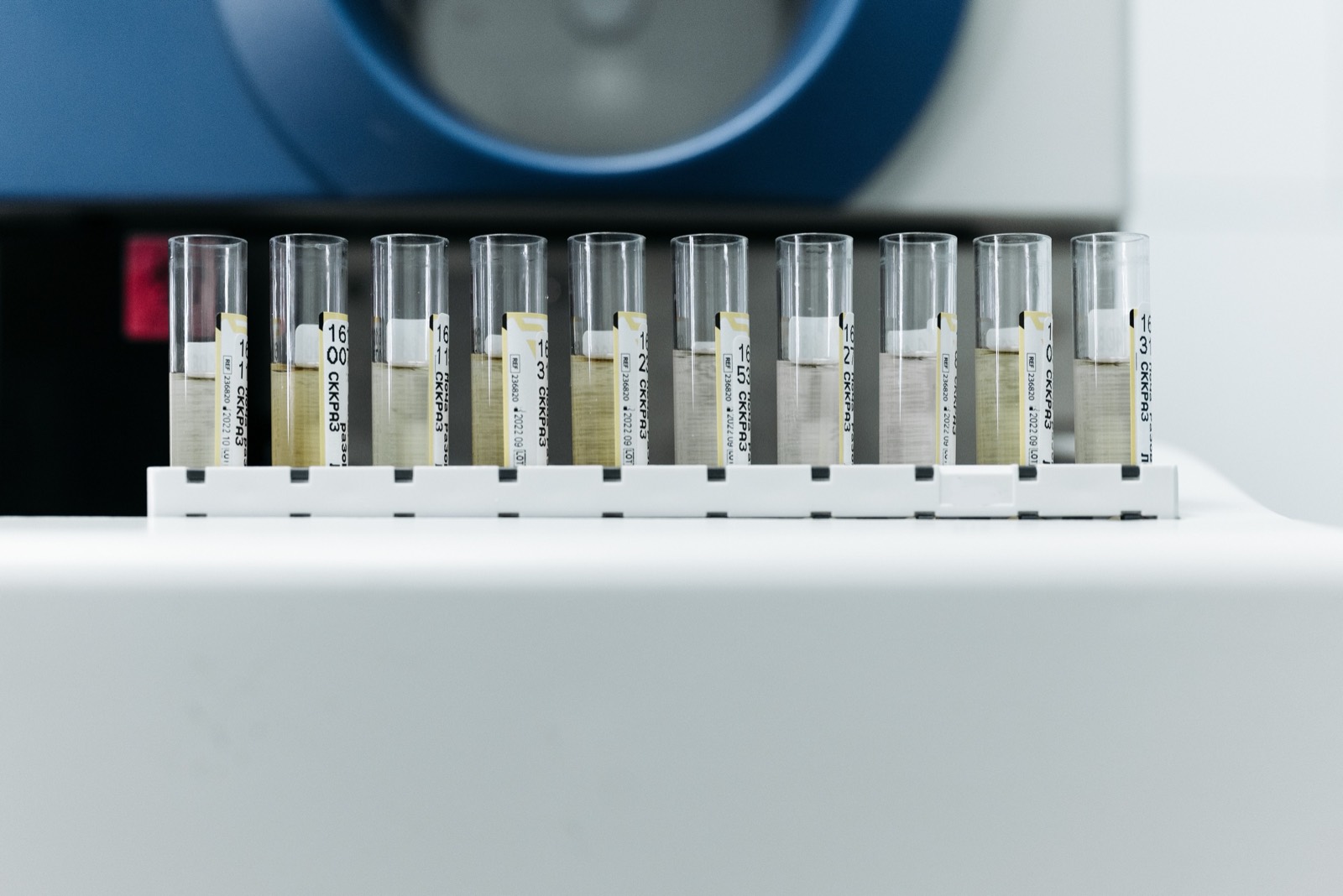
It is not one tap that gets tested, it is the whole building. The lab takes samples at several points: at the hot water tank outlet, on the circulation pipe, and at the outlets furthest from the tank, usually showers.
That is why a single sample from the kitchen proves nothing. Only several places together show whether the problem sits in the whole building or in one riser.
What comes out is a number for each place. It says how many Legionella were in the water, counted in colony-forming units per 100 millilitres. From 100 of them you have to act. What exactly is covered under Legionella in drinking water: what to do.
Who is actually required to test?
The obligation applies when four conditions come together: handing that water on commercially or to the public, a water heating system with a tank of more than 400 litres, or more than 3 litres of water in the pipe between the heater and the point of use, not counting the circulation pipe, points of use that create aerosols such as showers, and an installation that is not in a single- or two-family house. For hotels, clinics and care homes, all four almost always apply.
Which Legionella testing intervals apply?
| Facility | Standard interval | Note |
|---|---|---|
| Hotels and other accommodation | annually | supplied to the public |
| Hospital, clinic | annually | supplied to the public |
| Care homes and sheltered housing | annually | supplied to the public |
| Letting of residential property | every 3 years | purely commercial supply |
| After 3 years with no adverse findings | extension to up to 3 years possible | not for hospitals or care facilities |
| After the action level is exceeded | as ordered | the public health authority decides |
These intervals are the standard case. After three consecutive years with no adverse findings, the public health authority may extend the interval to up to three years, provided the installation and the way it is run have not changed and demonstrably meet at least the generally accepted rules of technology. This extension does not apply to facilities under § 23(5) of the Infection Protection Act, which covers hospitals, rehabilitation, dialysis and day clinics among others, nor to care facilities and other settings with patients at higher risk of Legionella infection (§ 31 (3) sentence 2 TrinkwV); there the annual interval remains. The public health authority can order additional tests where it considers them necessary to protect health.
What the cost depends on
Nobody can honestly quote you a price without knowing your building. What it comes down to is no secret, though. Three things decide almost all of it.
How many samples your building needs. That is settled by the pipework, not by the lab: a building with two risers is a different job from one with twelve. More samples cost more, and there is no way round it.
Whether the sampling is included. The lab is not allowed to just analyse the samples, it has to take them as well. A quote that covers the analysis alone is cheaper because it covers less. Ask about it before you put two quotes side by side.
How often it comes round. Hotels, hospitals and care homes test every year; rented flats every three years. Over ten years that is ten tests instead of three or four. That sum usually weighs more in the end than the price of a single sample.
How to get your own number. For a firm quote, the lab has to know how the building is put together: how many risers there are, whether there is a circulation loop, how many rooms or flats hang off it. Have that ready and you get a price instead of a range.
What happens if the action level is exceeded?
The technical action level is 100 CFU/100 ml. If it is reached or exceeded, you are required to notify the public health authority without delay, to have the cause established, which includes an on-site inspection, to draw up a written risk assessment and to implement measures (§ 51 TrinkwV). The notification falls away only if you hold proof that the approved testing laboratory has already made it (§ 51(1) no. 1 TrinkwV). Above 10,000 CFU/100 ml the hazard value applies: immediate measures up to a shower ban are then possible. What to do after a positive result, in order, is set out step by step in a separate article.
How a finding should be classified depends on the measured concentration. The following classification summarises what action is required from which value:
You are under the action level. The Drinking Water Ordinance requires no further measures. In areas with patients at higher risk, the facility’s own hygiene plan applies on top.
Action level reached or exceeded: notification to the public health authority, cause-finding with an on-site inspection and a written risk assessment required.
Immediate risk assessment, and the measures that follow from it. A usage restriction should be considered.
Imminent danger: immediate measures up to a shower ban.
The action level of 100 CFU/100 ml is set by the Drinking Water Ordinance (Annex 3 Part II), and the duties that follow from it by § 31 and § 51 TrinkwV. The values of 1,000 and 10,000 CFU/100 ml come from DVGW W 551 and are brought together in the Umweltbundesamt recommendation of 14 January 2021. Chart: Aqvior.
What testing does not replace
A sample is a snapshot: it shows the day the water was drawn, and nothing else. Whether water was regularly exchanged in the months before and after, it does not say. That is exactly what regular flushing requires, and exactly what you must be able to prove during a test.
Nor does it replace temperature management. A result above the action level often has its cause there: DVGW worksheet W 551 names 60 °C at the tank outlet and 55 °C in the circulation return. The Drinking Water Ordinance itself names no temperature values.
How long and how often flushing is required