Positive Legionella result in a hospital: the costs keep running
Thirty days after the positive result, the second box of shower filters arrives on the ward. That afternoon the finance director calls the head of technical services with two questions: what is this costing us, and for how long?
Most people answer the first question by adding up the invoices on the desk. That falls short. A positive Legionella result is not a bill you pay once. It is a cost that keeps running every week until the installation has been remediated, so the question that really decides the total is the second one.
What happens after a positive result
A positive result means the lab has found Legionella at or above the action value: the level at which the Drinking Water Ordinance requires the operator to act, 100 CFU (colony-forming units, i.e. Legionella detected) per 100 ml of water. From that moment, a fixed sequence starts. The hospital reports the result to the Gesundheitsamt (local public health authority), has the cause investigated, and has a risk assessment drawn up: an expert checks the whole drinking water installation for weak points. Then the cause is fixed in the installation (remediation), and follow-up samples show whether it worked.
That sequence takes time, because each step depends on the one before. While it runs, patients still need to shower safely. That is the job of the temporary measures, and it is where the running costs begin. The legal steps one by one are set out in what to do about Legionella in drinking water.
What the waiting costs
Until the cause has been removed, the hospital protects patients in four ways, and each of them costs something every week.
Filters.
Showers that stay in use get a filter fitted directly on the shower. Each one is replaced after the time its maker sets, usually 30 days.
Closed showers.
Showers that cannot be protected are closed. A closed bathroom can take a whole room out of use; in a care home, it is part of someone's home.
Extra flushing.
Someone from technical services flushes the affected showers by hand and writes down every round.
Staff time.
The hygiene team spends hours on inspections, meetings and records, time that is missing elsewhere.
Only part of this can be priced. Take an example with 20 affected showers, flushed daily: the risk assessment, disinfection, follow-up samples and flushing come to around €5,700 over five weeks by our estimate, not counting filters. Every further week adds around €300 for flushing alone. Filters, staff time and closed rooms come on top, but no invoice ever shows them together.
In the most sensitive parts of a hospital, the costs can start even earlier. For high-risk areas, the Umweltbundesamt (German Environment Agency) recommends acting as soon as any Legionella is found: after a hygiene assessment, use is restricted or filters are fitted, even before the action value is reached. It is a recommendation, not law.
Why waiting is the expensive option
Temporary measures are like a bucket under a leaking roof. It keeps the floor dry. Someone has to empty it every day. And the roof still leaks. The longer the roof goes unrepaired, the more you pay.
The chart shows what that means in our example. It only counts what can be priced, so the real totals are higher.
Worked example, estimate
What can be priced, by time until remediation
Source: market prices, 2020 to 2026, own estimate; follow-up samples: City of Nuremberg laboratory fee schedule. Own illustration.
And the bucket is not allowed to stay there for good anyway. The DVGW, the German association that sets the technical rules for drinking water, treats filters on the showers as a temporary measure until and during remediation. An installation that relies on them for good does not meet the Drinking Water Ordinance, however often they are changed. In the conversation with the finance director, this is the hygiene team's strongest argument: putting remediation off does not save money, it only means emptying the bucket for longer.
What to bring to the budget meeting
There is no published benchmark to compare with yet. When the Drinking Water Ordinance was rewritten in 2023, neither the federal government nor the states knew how many positive results there are in Germany. Only since then have labs had to report them to the Umweltbundesamt (German Environment Agency). So the best figures are your own. Split them into two groups: what has already been paid, such as the risk assessment, and what keeps running every week.
The second part only stops with remediation, so three questions belong on the agenda: who has commissioned the specialist contractor, for which date, and who makes sure that date holds?
One more figure is worth knowing, although it does not belong in the budget. Anyone who, for example, does not draw up the risk assessment, or draws it up too late, commits an administrative offence, and the Infection Protection Act allows a fine of up to €25,000 per offence. Following the sequence is the cheaper path in every sense.
So back to the phone call on day thirty. The honest answer to "what is this costing us?" is a weekly amount that is still running. The answer to "for how long?" is a name and a date, and that date is where the costs stop.
Flush before it gets urgent
The call on day thirty shows one thing above all: behind a positive Legionella result there are many costs nobody thinks about beforehand. Filters, closed rooms, staff hours and weeks of waiting only appear once the result is in. The best time to look after the water is therefore before there is a problem.
Much of the work that piles up after a positive result is work the hospital already knows: flushing showers regularly and recording it, as the flushing plan already sets out. After a positive result it simply happens under pressure, more often and with a file at the public health authority.
Aqvior's hygiene flush device does this work at the showers regularly, before there is a problem. It flushes on schedule and stores every flush with timestamp, duration and water temperature in the web dashboard, so the record is complete without anyone walking the ward with a list.
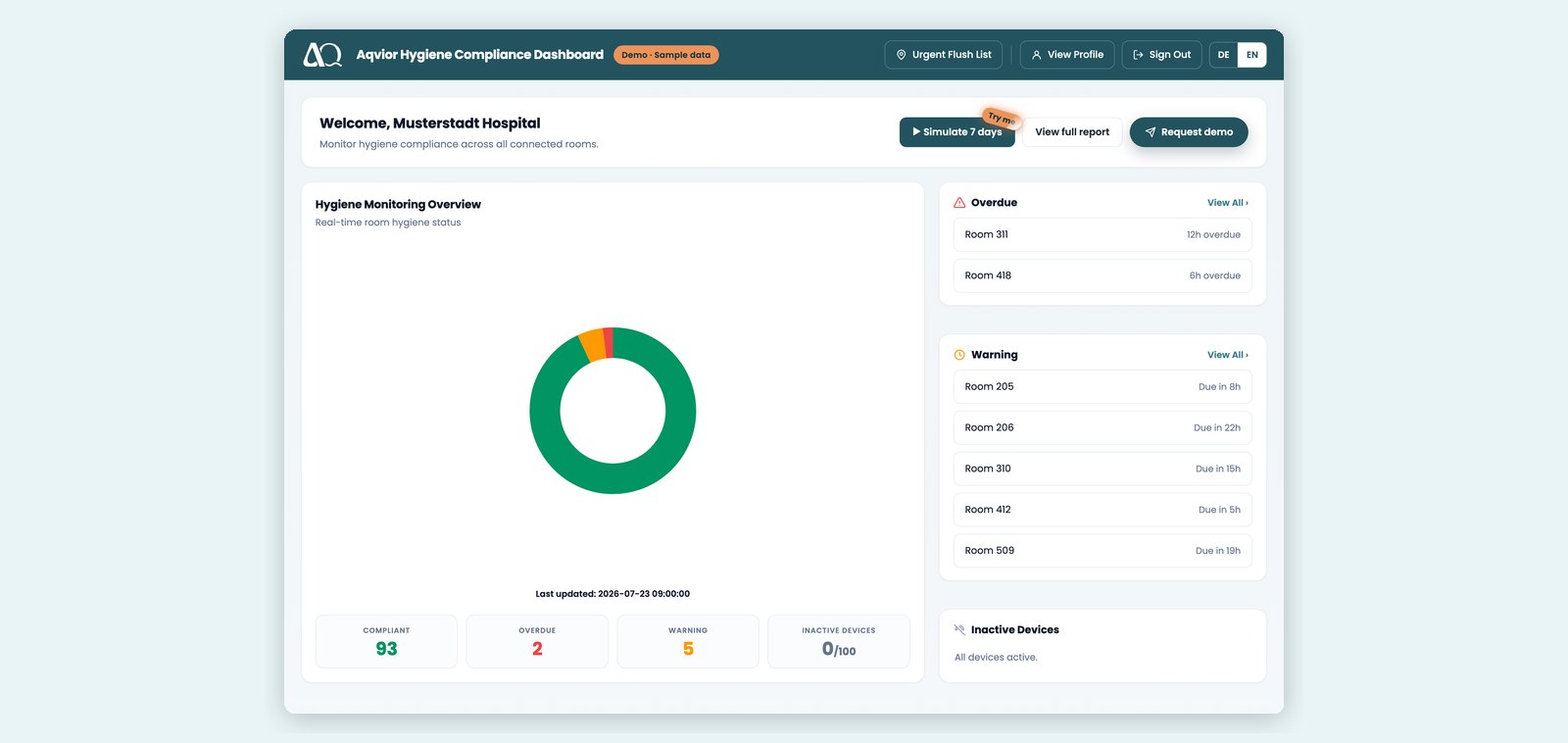
The device is prevention. It is not the answer to an existing positive result, and it replaces neither Legionella testing nor remediation. Washbasins and other outlets keep their own routine. Your own technician installs the device in under an hour, with no power connection. More on drinking water hygiene in hospitals.
Frequently Asked Questions
How long can shower filters stay on after a positive Legionella result?
Only until the cause has been removed. The DVGW provides for filters on the showers until and during remediation, not as a permanent solution. Until then, each filter is replaced no later than the end of the service life its maker sets, usually 30 days.
What do follow-up samples cost after a positive Legionella result?
There is no single price: it depends on the lab and on how many samples your installation needs, and depending on the lab, call-out and sampling on site come on top. So ask your lab directly for a quote. What a test involves is set out under Legionella testing.
Who coordinates the risk assessment in a hospital?
In medical facilities, the Umweltbundesamt gives this role to the hospital hygienist in its recommendation of October 2025. This version is not yet binding, because the Drinking Water Ordinance still refers to the 2012 recommendation. Technical services supply what the inspection needs: drawings, temperatures and access to every part of the installation.
Sources
- Bundesrat (2023): Drucksache 68/23, ordinance reorganising drinking water law (in German)
- Bundesministerium der Justiz (2023): Drinking Water Ordinance (TrinkwV), § 51 operator duties regarding Legionella spec. (in German)
- Bundesministerium der Justiz (2023): Drinking Water Ordinance (TrinkwV), § 72 administrative offences (in German)
- Bundesministerium der Justiz: Infection Protection Act (IfSG), § 73 fine provisions (in German)
- DVGW (2025): twin: temporary use of point-of-use filters in microbially contaminated drinking water installations, 02/2025
- Umweltbundesamt (2021): Update of the 2006 recommendation "Periodic testing for Legionella in central hot water systems of domestic installations", 14 January 2021 (in German)
- Umweltbundesamt (2025): Carrying out a risk assessment for Legionella spec. under § 51 of the Drinking Water Ordinance, recommendation of 13 October 2025 (in German)
- Stadt Nürnberg (2024): Environmental analysis fee schedule, 80th supplement, August 2024 (in German)
Flush before it gets urgent
Aqvior flushes the showers automatically on schedule and stores every flush with timestamp, duration and temperature, as part of everyday operation.
Automatic, on schedule · Every flush on record · Retrofitted without bathroom renovation
Stay current without going looking
Once a month: what we have published on drinking water hygiene, and what we are working on at Aqvior.
Thank you. Please confirm your email address.
The content of this article is for general information and does not replace legal, technical, or health-related advice in individual cases. Information on Legionella and associated health risks is general in nature and constitutes neither medical advice nor an assessment of a specific drinking water installation. For implementation in your operation, clarify your specific situation with the responsible Gesundheitsamt (local public health authority). This article contains links to Aqvior products.