
Automatic flushing device: six questions no quote will answer
The manager of a care home has a quote for an automatic flushing device on her desk. The demo was convincing, and she is due to sign on Monday. But the demo did not take place in her building: not in room 14, not at three in the morning, and not on the day the inspector asks to see the logs.
In the hospital's technical office, the head of technical services has the same quote in their inbox, and questions of their own. Will a wall have to be opened up? Will a shower start running by itself at night? And who notices if an outlet has not been flushed for three weeks? These questions will be answered either way: before you sign, or afterwards, in day-to-day running. If a quote like this is on your desk right now, ask them first.
- Does your existing shower valve stay, or does the bathroom have to be rebuilt?
- What do residents and patients notice, during installation and at night?
- What does each individual entry in the log actually prove?
- Who finds out about a missed flush?
- What does the system cost in total, over the years?
- Can you test it in your own building first?
Device or building site: the answer is in your shower valve
The first question can be settled before the next meeting, by looking into any bathroom in the building. Does the valve sit visibly on the tiles (exposed), or is it built into the wall (concealed)? Not every system fits both. Then ask what gets unscrewed, whether the wall or tiles have to be opened up and where the power comes from, because running a cable to every shower is building work too. The answer tells you whether you are buying a device or booking the builders.
Then time matters. In a care home the bathroom is part of a resident's home: every hour of installation is an hour with strangers in their bathroom. On a hospital ward the same question sounds different: does a bed have to be taken out of use? Once it is in, the part no demo shows begins: the first night.
At three in the morning, no shower should frighten anyone
Three in the morning, room 14: the shower starts running, and nobody has turned it on. For a resident with dementia that is not a technical detail, and on a ward the same goes for patients who need to sleep. So ask whether the flush can be heard in the room and whether it can start while someone is standing in the shower. The night went well if nobody noticed anything. But if nobody noticed anything, nobody can vouch for it either.
An open valve is not proof
When the inspector asks for the logs, nobody will have been there when the flushing happened. All that counts is what was recorded. So what you are really buying is the record, and that is exactly what a one-off demo shows least.
It is like an alarm clock: the alarm going off does not mean anyone got up. An entry such as "valve opened, 03:14" shows that the valve opened, not that the water was exchanged. So ask whether every flush also stores the duration, the volume and the temperature, and how you export the records for a given period as a file for an inspection. The volume shows that water really ran, the temperature how warm it was when it reached the shower.
A record is only as good as the plan it is checked against. The technical standards normally call for a water exchange at least every 72 hours, and shorter gaps in hospitals and care homes. How short is set by your flushing plan, not by the device, so ask whether the interval can be adjusted. How often and how long to flush is covered in our article on Legionella flushing in drinking water.
When a flush does not happen, someone has to notice
A record has an awkward flip side: it also shows the night when no flush happened. An automatic flushing device takes over the rounds, not the responsibility. VDI 6023 (the German hygiene standard for water installations) is explicit on this point: if the water exchange depends on electronic components, someone has to check that they work.
So ask plainly: how do we find out if a shower is not flushed one night, and who hears first? A hospital's head of technical services will want the alert in the building management system. A care-home manager without a maintenance team of their own needs something simpler: an overview that lands on their desk and makes sense without a training course.
Involve the person who will show the logs to the inspector early on: in a hospital the infection control nurse, in a care home the hygiene officer or the head of nursing. Our pages on drinking water hygiene in hospitals and in care homes cover what else an inspection looks at.
Test where it gets difficult: at the shower nobody uses
The demo showed that the system works. Only a few weeks on your own showers, and not the easy ones, will show whether it works in your building. In a care home that might be the room left empty while its resident spends three weeks in hospital, or the bathroom of a resident who now only has bed baths. In a hospital, good candidates are the shower in an isolation room that hardly anyone enters, or the staff shower in the basement.
Testing in your own building
A meaningful test in three steps
Six questions before you buy an automatic flushing device
These six questions fit on a single sheet of paper. Put it next to the quote before anything is signed.
Does our shower valve stay on the wall?
Does the system fit our valves, and do any tiles have to come off?
What do residents and patients notice?
How long the shower is out of use, whether the flush can be heard at night and whether it starts while someone is showering.
What does each individual entry show?
Not only that the valve opened, but duration, volume and temperature, and how we export a period as a file for an inspection.
Who hears about a missed flush?
And who do we call when something does not work?
What does it cost in total, over the years?
The cost per shower, the running costs and the cost at the end of the contract, including what then happens to our data.
Can we test it on our hardest showers first?
And which comparable facilities already use it?
With that sheet, the quote on the desk looks different. Not every answer will be the one you hoped for, but none will come as a surprise after you have bought.
We at Aqvior can answer some of these questions right now. Our hygiene flush device for exposed shower installations sits behind a shower's existing valve. Thermostat, hose and shower head remain, your own caretaker or maintenance staff can install it in under an hour, and it needs no power connection.
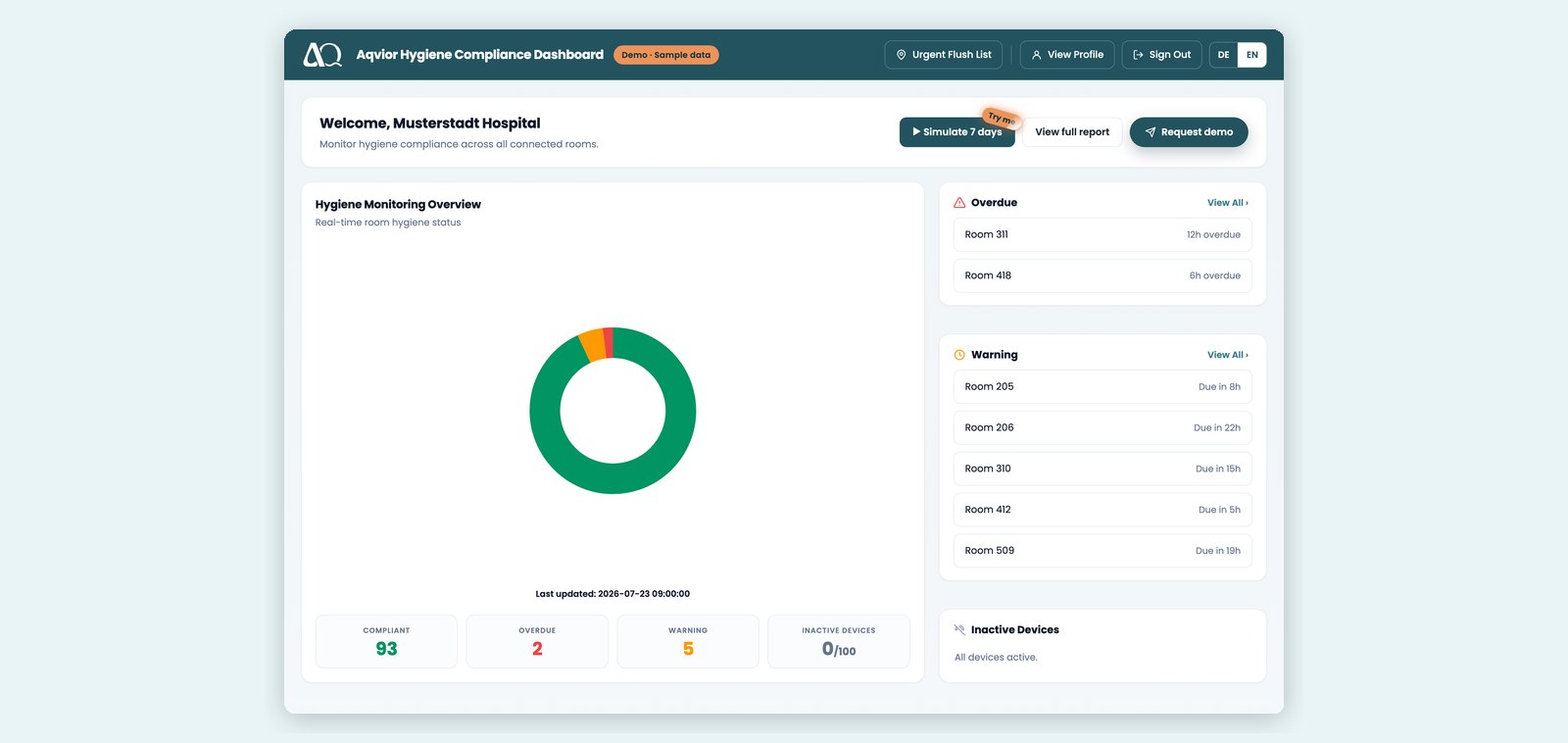
If no water has run at the shower for 72 hours, the device flushes; in hospitals and care homes the interval can be set shorter. A flush does not start while the shower is in use. Every flush is logged in the web dashboard with time, duration, volume and water temperature and kept there for ten years; the report for an inspection downloads as a PDF in one click. Once a month, an overview goes to whoever works with the dashboard in your facility, for example the hygiene officer or the management. Washbasins and other outlets remain part of your drinking water flushing plan.
What it costs your facility over the years, and every technical detail, is best worked out together with you: Talk to us.
Frequently Asked Questions
Is automatic flushing as good as flushing by hand?
In hygiene terms, yes: VDI 6023 treats the water exchange by an automatic flushing device as equal to flushing by hand. The requirements remain the same. The difference is in day-to-day work:
| By hand | Automatic with Aqvior |
|---|---|
| Every shower is turned on and off by hand | The device flushes by itself |
| Nobody measures how long it ran, so more water runs to be safe | Duration, volume and temperature are measured |
| Records are kept on paper | Every flush is logged digitally in the web dashboard |
| The round costs working time, for example in cleaning | Installed in under an hour, with no cable connection |
| Hygiene staff check lists and chase gaps | Hygiene staff get a monthly overview |
Own illustration.
Does automatic flushing replace Legionella testing?
No. Where Germany's Drinking Water Ordinance requires testing for Legionella, it remains mandatory, in care homes and hospitals usually once a year. The Gesundheitsamt (local public health authority) cannot extend that interval for them, even after years without a positive result, however well the water is flushed. More in our article on Legionella testing.
Does an automatic flushing device have to cover every shower?
No. You can start where water sits longest. The shower is where the risk is highest, because the water is turned into a fine spray there (why the shower is the critical point). The flushing plan then states which outlets are flushed automatically and which remain in the flushing round. What matters is that none falls through the gaps, not even the assisted bathing room at the end of the corridor. If automatic flushing covers every shower, the manual round disappears there, along with the working time it takes. And if there is ever a positive result, you have a record for every shower of when it was last flushed.
Sources
- Bundesministerium der Justiz (2023): Section 31 TrinkwV: testing obligations for Legionella (in German)
- Bundesministerium der Justiz: Section 23 IfSG: nosocomial infections, resistance, state regulations (in German)
Every flush on record, and your shower valve stays
When a shower stands unused too long, our device flushes it by itself and records every flush. Test it on the showers in your building where the least water runs.
Your shower valve stays · No power connection · Installed in under an hour
Stay current without going looking
Once a month: what we have published on drinking water hygiene, and what we are working on at Aqvior.
Thank you. Please confirm your email address.
The content of this article is for general information and does not replace legal, technical, or health-related advice in individual cases. Information on Legionella and associated health risks is general in nature and constitutes neither medical advice nor an assessment of a specific drinking water installation. For implementation in your operation, clarify your specific situation with the responsible Gesundheitsamt (local public health authority). This article contains links to Aqvior products.